The unanimous Declaration of the thirteen united States of America
a dissection
This page changed with the April 29, 2024 edit.
This page changed with the April 29, 2024 edit.
Purpose: Unify Colonies, but not for declaring independence; Support Boston. On October 14, 1774, the First Continental Congress issued Declaration of Colonial Rights and Grievances. An attempt to return peaceable relationships between British Motherland and the colonies. Much of the Declaration of Colonial Rights and Grievances content became part of The unanimous Declaration of the thirteen united States of America; which dissolved all political bands with Great Britain.
—But we're taught to call it A Declaration of Independence, to forget about it. Politically motivated people tell us; "It's just there to remind us that we were once under British Rule. We don't need that old dead paper".
(K. Notes: Is where the annotations are placed and appear in this indented manner. Sometimes to simply define a word from a 1756 Dictionary set. In this instance, the dictionary by Samuel Johnson. Remember, Webster did not publish his first dictionary until 1806, thirty years after the signing of The unanimous Declaration.
(K. Notes: Congress approved the draft on July 4, 1776; then submitted it to the states for ratification. By Aug 2, 1776; thirteen states ratified the contract.

CONGRESS [s.]
2. An appointed meeting for settlement of affairs between nations.

NATION [s.]
A people distinguished from another people.

STATE [s.]
5. The community; the publick; the commonwealth.
6. A republick; a government not monarchial.
10. A seat of dignity.
13. The principle persons in the government.
(K. Notes: The definition for State is included because The Declaration, towards the end, refers to Great Britain as a State.
We see that the definitions are quite similar with respect to the 'people' the 'publick', and the 'community'.
State, also refers to the seat of government.
Throughout this Declaration, The Articles of Confederation and The Constitution of the United States of America; the words state, State, or several States, could refer to the people generally, the individual states in the union, or the nation's government.
To muddy things a bit, towards the end of The Declaration it states, "the State of Great Britain". This use would be in direct conflict with the 1756 State definition #6, which excludes monarchial governments, being kings and queens.
This demonstration is to show how important it is to double-check the context of how the words are actually used in a specific phrase, sentence or paragraph; then, find the best matching definition for the correct contextual usage. With these dissections, I can only hope that all my selections hold to this standard.
When in the Course of human events, it becomes necessary for one people to dissolve the political bands which have connected them with another, and to assume among the powers of the earth, the separate and equal station to which the Laws of Nature and of Nature's God entitle them, a decent respect to the opinions of mankind requires that they should declare the causes which impel them to the separation.
(K. Notes: The phrase, When in the Course of human events, is often forgotten when people consider whether this document applies to post 1776 generations. To this, we need simply ask one question: Are we still in the course of human events? Yes, we are still in the course of human events. Therefore, while still in the course of human events, the following content will be useful.
(K. Notes: The phrase, it becomes necessary for one people to dissolve the political bands which have connected them with another, is useful to remember as populations grow and diversify their industry. Had President Washington remembered this, as the whiskey States tried to secede; and President Lincoln, as the slave states seceded; the united States of America's history would be less blood stained.
As populations increase to the point the existing government of the main group no longer protects its minority members; it is better to allow them to part as friends. Otherwise, trying to force them to remain as conquered enemies, seems most likely to cause continuing political problems.
These splitting-off divisions are natural with life in general; right from the point of conception, through maturity. It happens with the local, county, state, and national unions. These splitting-off of members is quite common within families. Whether one party objects to the parting or not; it makes all the difference in the level of resistance the one contesting the separation makes as to whether they live at peace with each other or constantly warring.
(K. Notes: When it states: and to assume among the powers of the earth, the separate and equal station to which the Laws of Nature and of Nature's God entitle them, the child then assumes among humankind, a separate and equal station with all other adults, parents included. We see this in nearly all formation of corporations, whether commercial or government. The larger body splits and becomes two or more equal-type entities, though not necessarily equal in size or same abilities.
When a society recognizes that these separations are part of nature; that they are not to be resisted; they work to make certain that as many as all members become as well-informed in managing social business as they can, so that when that separation happens; they part as friends, willing to come to the aid of the other, when needed.
(K. Notes: This clause; a decent respect to the opinions of mankind requires that they should declare the causes which impel them to the separation; should be the first step towards departing on friendly terms.
This also answers the question as to: Why? What are the reasons for the separation? The point of justification, or not, are relative to the two parties. If the departing community needs the assistance of others to effect the separation; others must be able to see that the reasons are justifiable. If justifiable, it will be easier to get the help of others. Many separations happen with little visible violence. Others separations end after blood-baths that nearly wipe out all parties involved.
We hold these truths to be self-evident, that all men are created equal, that they are endowed by their Creator with certain unalienable Rights, that among these are Life, Liberty and the pursuit of Happiness. —That to secure these rights, Governments are instituted among Men, deriving their just powers from the consent of the governed, —That whenever any Form of Government becomes destructive of these ends, it is the Right of the People to alter or to abolish it, and to institute new Government, laying its foundation on such principles and organizing its powers in such form, as to them shall seem most likely to effect their Safety and Happiness. Prudence, indeed, will dictate that Governments long established should not be changed for light and transient causes; and accordingly all experience hath shewn, that mankind are more disposed to suffer, while evils are sufferable, than to right themselves by abolishing the forms to which they are accustomed. But when a long train of abuses and usurpations, pursuing invariably the same Object evinces a design to reduce them under absolute Despotism, it is their right, it is their duty, to throw off such Government, and to provide new Guards for their future security. —Such has been the patient sufferance of these Colonies; and such is now the necessity which constrains them to alter their former Systems of Government. The history of the present King of Great Britain is a history of repeated injuries and usurpations, all having in direct object the establishment of an absolute Tyranny over these States. To prove this, let Facts be submitted to a candid world.
(K. Notes:
We hold these truths to be self-evident,
Evident — (1756 Image)

Evident [a.]
Plain; apparent notorious.

Notorious [a.]
Publickly known; evident to the world; not hidden.
(K. Notes: This statement, 'We hold these truths to be self-evident', introduces a list of information that claims is truth, and that such truths that are so obvious that anyone, anywhere, should be able to recognize them.
(K. Notes: that all men are created equal,
Men — (1756 Image)

Men []
Men, the plural of man.
(K. Notes: But does this include or exclude women, children, people of other colors, and slaves; or even the poor and homeless people?

Man [s.]
1. Human being.
2. Not a woman.
3. Not a boy.
4. A servant; an attendant; a dependant.
6. It is used in loose signification like the French on, one, any one.
8. A human being qualified in any particular manner.
9. Wealthy or independant person.

Human [a.]
1. Having the qualities of a man.
2. Belonging to man.


Person [s.]
1. Individual or particular man or woman.
2. Man or woman considered as opposed to things.
3. Human Being.
4. Man or woman considered as present, acting or suffering.
5. A general loose term for human being.
8. Man or woman represented in a fictitious dialogue.
(K. Notes: The best way to comprehend this word and the most appropriate definition is to define several other words now, that get used later. Words, such as; human, people, mankind, men, governed, colonies, citizens, and kindred. For that task, the 1756 dictionaries are available for download on the Older Dictionaries. For now, we simply see how general the words are as they relate to groups of humans. Generally, they are all-inclusive.
Though historical application seems to favor 'Man' definition #11 with 'Wealthy or independent person'; to be consistent throughout the document, we must consider the 'Man' definition #8 as contextually correct, 'A human being qualified in any particular manner'. Thus, inclusive of men, women, people of color, slaves, and the homeless; as all can be qualified as human beings.
Equal — (1756 Image)

Equal [a.]
1. Like another in bulk, or any quality that admits comparison.
Equal [s.]
1. One not inferiour or superiour to another.
(K. Notes: Since we rapidly observe, all humans are not equal in all aspects. Some are taller, fatter, skin-color, wealth, education, etc. different than each other. How are all humans equal?
(K. Notes: The previous question is answered by this phrase. that they are endowed by their Creator with certain unalienable Rights, that among these are Life, Liberty and the pursuit of Happiness.
To Endow — (1756 Image)

To Endow [v. a.]
1. To enrich with a portion.
2. To supply with any external goods.
3. To enrich with any excellence.
4. To be the fortune of any one.

Creator [s.]
Creator. The being that bestows existence.

Inventer [s.]
1. One who produces something new; a deviser of something not known before.
(K. Notes: Unalienable — 1756
The word 'unalienable' does not appear in the 1756 dictionary, so we take the long way around by defining 'un,' and then, 'alienable'

un []
A Saxon privative or negative particle answering to in of the Latin, and a of the Greeks, on, Dutch. It is placed almost at will before adjectives and adverbs.

Alienable [a.]
That of which the property may be transferred.
(K. Notes: Then, since 'inalienable' and 'unalienable' seem to get used interchangeably, we also define 'inalienable'

Inalienable [a.]
That cannot be alienated.

To Alienate [v. a.]
1. To transfer the property of any thing to another.


Right [a.]
1. For; proper; becoming; suitable; true; not erroneous.
3. Just; honest; equitable.
4. Happy; convenient.
Right [interjection.]
An expression of approbation.
Right [ad.]
1. Properly; justly; exactly; according to truth.
Right [s.]
1. Justice; not wrong.
5. Property; interest.
6. Power; prerogative.
7. Immunity; privilege.
(K. Notes: By definition, creator does not specify god or even supreme being. Just a cause that brought humans into existence. Then we see that the first definition for 'Inventer' is very similar to 'Creator'.
If a 'Creator'. bestows existence, and the 'Inverter' produces something new; A creator and an inventer are much the same. A "creator" seems less knowable and more mysterious than an inventer, which makes since. After all, much of the human race disagrees as to who or what caused humans to exist; so a level of vagueness on the matter would probably be a good thing. Unfortunately, as human nature would also have it, we tend to re-configure things to suit our desired outcome.
According to the document, that inventer or creator has given to humans, our rights; at least the un- or in-alienable ones. Question is: How many unalienable rights do we possess? Many people, unfamiliar with the actual words have almost instantly proclaimed three!
We know that three is a short list. Remember the words that preceded the three rights listed? "That among these are...". It is in that unnumbered list of rights to which we all are equal. In no other known aspect are any of us equal. Not even identical twins are entirely equal. They do not occupy the same space at the same time, but their list of rights is identical.
Similar to entering a massive shopping mall with an endless supply of every product; two very similar people will enter, spend different amounts, select different products, buy different quantities even if they buy some of the same products, etc. So too is it with our list of rights. Some people select entirely different rights from that list. Those that select some of the same rights place differing values of importance on the same right.
Hopefully, people have asked and correctly answered the question as to: What is a right? If not we can take prompts from several of the rights listed in The Declaration, jump a few years into the future to The Constitution, then list some more of those rights. We come up with: to alter, to abolish, to throw off (with respect to corrupted governments and the officers within); not to mention consent, which is to vote. Then, we also have, life, liberty, and the pursuit of happiness or property. The Constitution mentions, speech, press, assembly, petition, keep and bear (with respect to arms), vote, as well as others.
Rights are actions. They are actions we do. They also are actions that we do not want others to do against us; such as, not be coerced to testify against ourselves, not have our privacy or security unjustly invaded, not to have our vote infringed, violated or ignored; among others.
Rights, honorable rights that do not unjustly violate another person's rights are simply things or actions humans have done before government passes laws to limit, infringe, deny, disparage, or violate those rights. On this point, an astute government officer trying to trap a person concerning rights will mention that humans have been killing other humans before the laws prohibiting killing were established.
With respect to killing there are distinctions. The extremes being self-defense or the defense of others. The other extreme is unjustified, premeditated killing, thus murder.
While murder unjustly violates another person's right to life; prostitution, drug-use, gambling, among many other examples, are actions by and between (hopefully) consenting adults. If a person is forced into prostitution, than the person forcing them is guilty of violating the forced person's right to not participate (same with unwilling spouses and partners). If another person spikes your drinks or food with addictive substances that weaken the attitude toward or increase the likelihood toward doing something, that person who secretly added the unwanted substance, has violated the other person's rights.
(K. Notes: This clause accomplishes a couple important objectives: —That to secure these rights, Governments are instituted among Men, deriving their just powers from the consent of the governed.
It identifies the singular purpose for the government being created by the union identified within this contract.
It identifies the source from which that government may rightly attain any power.
It identifies the sovereign authority over the government.
It identifies who may rightly exercise their right to vote.
It also specifies the vote-count method for determining whether or not any thing or any person on a given ballot was accepted or rejected by the body of voters.
To Secure — (1756 Image)
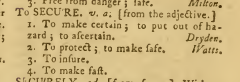
To Secure [v. a.]
1. To make certain; to put out of hazard; to ascertain.
2. To protect; to make safe.

To Institute [v. n.]
1. To fix; to establish; to appoint; to enact; to settle.
2. To educate; to instruct; to form by instruction.

To Derive [v. a.]
2. To deduce from its original.
To Derive [v. n.]
1. To come from; to owe it origin to..
2. To descend from.
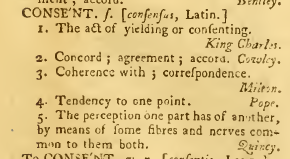
Consent [s.]
1. The act of yielding or consenting.
2. Concord; agreement; accord.
3. Coherence with; correspondence.
4. Tendency to one point.

To Consent [v. n.]
1. To be of the same mind.
2. To co-operate to the same end.
(K. Notes: Because too many people wrongly assume that when a registered voter does not submit a ballot, that they have not voted; we must consider the definitions also for 'yield' and 'abstain'.

To Yield [v. a.]
5. To allow; to permit.
7. To resign; to give up.
8. To surrender.
To Yield [v. n.]
1. To give up the conquest; to submit.
4. To concede; to admit; to allow; not to deny.

To Abstain [v. n.]
To forbear, to deny one's self any gratification.
(K. Notes: As we see by the 'yield' and 'abstain'; the only way that a registered voter may do either of them is to not register in the first place, or remove their name from the registry of voters in the second place. Otherwise, the registered voter who does not submit a ballot in any way, shape, or form; just as the person who has not registered as a voter; they resign themselves to accepting what the majority of the total body of register voters has agreed to. Which means, in accord with the definitions above, when the majority of register voters either refuse or fail to get a 'consenting' ballot to the polling station before it closes; those register voters, whether deliberately or through long-standing ignorance, have not consented to anyone or anything on their ballot.
Non-Consent is as valid a vote, as is 'Consent'; because the majority of the total body of registered voters have acted in accord, a meeting of the minds, and agreed that every thing and every one on those ballots should not be sworn into office or enforced.
(K. Notes: For added emphasis; we must realize that it is the duty of the party advancing a balloted item or candidate; to inform enough registered voters of the importance of them getting their Consenting Vote to the polling station; or the item or candidate must fail for lack of consent.
(K. Notes: Up to this point, it has all been positive in nature. From here, This Contract begins to instruct the governed people about what to do, when, not if; but When, the political shit hits the fan. —That whenever any Form of Government becomes destructive of these ends, it is the Right of the People to alter or to abolish it, and to institute new Government, laying its foundation on such principles and organizing its powers in such form, as to them shall seem most likely to effect their Safety and Happiness.
Notice the word, 'whenever'. This is not and if statement. This is another strong indication that this document was intended for use by future generations, for when their government becomes destructive to the security of the governed people's rights.
This also must be noted for clarity, that the security of the governed people's rights is not specific to merely those three listed. but to all of them that are included in the phrase, 'among these'.
What does it mean to 'alter' or to 'abolish'?
To Alter — (1756 Image)

To Alter [v. a.]
1. To change; to make otherwise than it is.
To Alter [v. n.]
To become otherwise than it was.

To Abolish v. a.]
1. To annul.
2. To put an end to; to destroy.
(K. Notes: For the sake of clarity, in The Constitution of the United States of America, Amendment 9, where it states; "The enumeration of certain rights in the Constitution shall not be construed to deny or disparage other rights retained by the people." These are two rights the people retained, especially for when government becomes destructive of protecting the citizen's rights.
To alter and to abolish bad government are rights that must be exercised when government begins to fail.
But these rights come with responsibilities and warnings, two in particular are next.
(K. Notes: This first warning cautions in favor of making certain that the change is necessary. Prudence, indeed, will dictate that Governments long established should not be changed for light and transient causes;
Prudence — (1756 Image)

Prudence [s.]
Wisdom applied to practice.

Light [a.]
8. Unemcumbered; unembarrassed; clear of impediments.
11. Easy to admit any influence; unsteady; unsettled.
13. Not chaste; not regular in conduct.

Transient [a.]
Soon past; soon passing; short; momentary.
(K. Notes: This is our first advisory warning about changing, altering, or abolishing forms of government. Wisdom must be applied to the proposed action. This wisdom might best come in the form of hind site; lessons from past successes and past failures.
Prudence, wisdom dictates, that governments (long) established, should not be changed to grant to government unlimited powers in any aspect, especially where it allows unwanted influences over that power. The powers of government should be seen to apply to more than the current circumstances that encouraged the alteration of government powers.
We should not try to grant powers to government that prohibit or limit the activities of other people, just because we do not like the activity or the person. Such limitations against a right, are then equally applied against everyone. The activity, if it is to be banned or limited, must be such that when exercised, it violates other people's rights. Then, and only then, should the limitation or prohibition punish only those individuals who abuse that right, and not a blanket prohibition against the entire society.
(K. Notes: This warning is to get the governed people to keep a constant watch on their government's activity, and to not let the seeming little constitutional violations slide; and accordingly all experience hath shewn, that mankind are more disposed to suffer, while evils are sufferable, than to right themselves by abolishing the forms to which they are accustomed.
Right from the beginning out the united States of America, as a people, we have remained very tolerant of political abuses, especially when those abuses were against others, and not us.
The founding generation was no exception. They continued slavery and women suppression even though the, 'all men are created equal' clause should have ended the practices in 1776. They also simply continued many of the unjust British political practices, simply because they they were familiar with them. They simply changed the names of the player and the names of the games, but the practices remain the same. This is detailed in just a little bit as we go through the list of grievances that identify our Domestic Enemies within our own government; those tyrants and despots who trample our rights.
However, Our nations pledge, at the very end of this dissection and the end of The Declaration, it insists that every united States America come to the aid of any person whose rights are unjustly attacked, whether by government, business, or other individuals. When this is done frequently people will find it futile to unjustly attack others, as an attack against one, --is an attack against us all.
(K. Notes: Just in case the previous two warnings go ignored; this makes it the governed peoples' duty to take action. But when a long train of abuses and usurpations, pursuing invariably the same Object evinces a design to reduce them under absolute Despotism, it is their right, it is their duty, to throw off such Government, and to provide new Guards for their future security.
Apparently the founding generation knew that this would even happen in these united States of America. If the list of nearly 30 political-power grievances qualifies as the long train of abuses and usurpations; it seems it is time for this generation of 2024 to throw off our present form of government and provide new guards for our future security. In just a little bit, we will go through each of the listed grievances. Then with a little explanation, describe how our present government branches and levels are exercising nearly every one of these prohibited powers, and in some cases what can only be described as, on steroids.
(K. Notes: With: —Such has been the patient sufferance of these Colonies; and such is now the necessity which constrains them to alter their former Systems of Government; the founding generation is admitting that they neglected their duty and had allowed themselves suffer, while those evils were sufferable.
The governed people of these united States of America might also proclaim: Such has been the patient sufferance through to the present year of 2024; and such is now the necessity which constrains us to alter our present Systems of Government and institute new government for our future security.
(K. Notes: With this clause, all that is needed is to change the names of the players to make it 2024, current. The history of the present King of Great Britain is a history of repeated injuries and usurpations, all having in direct object the establishment of an absolute Tyranny over these States.
The history of the present government within these united States of America is a history of repeated injuries and usurpations, all having in direct object the establishment of an absolute Tyranny over these united States of America and the world.
(K. Notes: This short clause introduces the list of grievances: To prove this, let Facts be submitted to a candid world.
He has refused his Assent to Laws, the most wholesome and necessary for the public good.

Assent [s.]
1. The act of agreeing to any thing.
2. Consent; agreement.
(K. Notes: Though our government officers (including all military and police) —in word only, by their swearing in oath, have agreed to and entered into a contract with the citizens by way of The Constitution of the United States of America, which is the first of four elements listed in The Supreme Law of the Land (Article 6, Paragraph 2). Their actions, by passing laws that violate that contract-Constitution, arresting and ticketing people for violating those unconstitutional laws, and punishing people for violating those unconstitutional law speaks of their refusing agreement to that Supreme law, the most wholesome and necessary for the public good —as the citizens have declared to be for their good.
Thus, the beginning of the long train of abuses and usurpations leading to an absolute tyranny and despotism over the people.
He has forbidden his Governors to pass Laws of immediate and pressing importance, unless suspended in their operation till his Assent should be obtained; and when so suspended, he has utterly neglected to attend to them.
(K. Notes: The above applies more for the non-state territories, districts, and possession where Congress must authorize their legislative actions.
He has refused to pass other Laws for the accommodation of large districts of people, unless those people would relinquish the right of Representation in the Legislature, a right inestimable to them and formidable to tyrants only.
(K. Notes: This also presently applies mostly to Washington DC and the various Territories. They are non-voting members in Congress, which really is no more than a citizen who may speak in and to Congress, but has no voting power to help steer the Congressional vote. Such "representation", if it can be called such, is not representation at all.
He has called together legislative bodies at places unusual, uncomfortable, and distant from the depository of their public Records, for the sole purpose of fatiguing them into compliance with his measures.
(K. Notes: As for the above: Presidents (just another name for king or queen) still influence Congressional (just another name for parliament) by threatening to veto a Bill (even if it is constitutional) unless Congress does some thing the President requests.
He has dissolved Representative Houses repeatedly, for opposing with manly firmness his invasions on the rights of the people.
(K. Notes: Every time, just one 'Representative' refuses to vote and debate in accord with The Constitution's terms, and in accord with the majority of their constituent's constitutional demands , —representation is dissolved.
Though just one can dissolve representation; each time the majority of Congress passes unconstitutional legislation, —they dissolve another Representative House.
He has refused for a long time, after such dissolutions, to cause others to be elected; whereby the Legislative powers, incapable of Annihilation, have returned to the People at large for their exercise; the State remaining in the mean time exposed to all the dangers of invasion from without, and convulsions within.
(K. Notes: Our Representative houses, in all levels of government remain dissolved, in that the people sworn into those offices were not lawfully elected by their constituent body of registered voters, in accord with the terms of The unanimous Declaration of the thirteen united States of America and the phrase Consent of the governed. They also, in majority numbers ignore constitutional limitations.
He has endeavoured to prevent the population of these States; for that purpose obstructing the Laws for Naturalization of Foreigners; refusing to pass others to encourage their migrations hither, and raising the conditions of new Appropriations of Lands.
(K. Notes: In present day, united States of America, we have the reverse problem. Our government officers, in opposition to our Law of Immigration and Naturalization, grant amnesty to large bodies of people who enter or remain within these united States of America illegally. That encourages even more to play the amnesty-lottery.
The control of immigration and naturalization by government is to stabilize the economics of society. Too many foreigners in a country at the same time, many of them working, especially when many citizens are looking for work, increases the unemployment rate of citizens in that country.
These united States of America has a two stage process to reduce illegal immigration. Stage 1: are the US Codes for first offense 6 months incarceration; second offense up to 2 years. Stage 2: is Amendment 13 where that incarcerated time is performing hard manual labor (hopefully in such a way as to reduce the need for private contracts that drain tax dollars because of incompetent government officers).
He has obstructed the Administration of Justice, by refusing his Assent to Laws for establishing Judiciary powers.
(K. Notes: Though there are plenty of judiciary powers established in the cities, counties, states, and national districts; they seem to refuse their assent or agreement to the most wholesome laws for society, as detailed earlier; ignoring the Constitution when it proves that the law in question violates The Constitution; thus punishing people for exercising Amendment 9 protected rights.)
He has made Judges dependent on his Will alone, for the tenure of their offices, and the amount and payment of their salaries.
(K. Notes: Many smaller-level political judicial jurisdictions are paid a "commission" based on number of convictions and or fines charged against defendants.
Even at the larger judicial jurisdiction levels, either or both, the legislative and or the executive branches nominate, appoint, or confirm those judges into office; or they have power to remove them. This opens the door to an incorrect loyalty to the political party or the politicians responsible for authorizing their judicial seat.
He has erected a multitude of New Offices, and sent hither swarms of Officers to harass our people, and eat out their substance.
(K. Notes: Another mark of tyranny in full effect within these united States of America. We have government offices for nearly every aspect of human life, with more being created. Each office has officers, unconstitutionally authorized to pass and enforce their own rules against the people. Nearly all requiring some sort of fee, fine, or tax to fund them; almost none of them authorized by the people or The Constitution.
He has kept among us, in times of peace, Standing Armies without the Consent of our legislatures.
(K. Notes:
Does it really matter what we call these standing armies? Police (park, metro, transit, library, parking, etc.), Sheriffs, Deputies, Troopers, Agents, National Guard, etc. They all seem permanently armed. Even by definition for army from 1756, police are considered "military".
Army — (1756 Image)

Army [s.]
1. A collection of armed men, obligated to obey one man.
A police force is taught to be obligated obey one Police Chief; deputies, one Sheriff; troopers or national guard, one Governor; etc.
The fact is, that all of them, within these united States of America, swear or affirm oath to obey, uphold, defend The Constitution for the United States of America, in many instances, against enemies foreign and domestic, not to become loyal to those unconstitutional laws or orders.
Military — (1756 Image)

Military [a.]
2. Suiting a soldier; pertaining to a soldier; warlike.
Anyone who has watched war movies, and seen our modern police forces; they notice how warlike the police are in appearance and training. Shoot first. Ask questions later.
Though most of the police have the "consent" of a legislative body to exist; that legislative body is assembled, in most cases, contrary to the will and vote of The Constitution and the people.
He has affected to render the Military independent of and superior to the Civil power.
(K. Notes: Our nation's armed forces, including the military, swears oath to The Constitution, against enemies, foreign and domestic. The Civil Power is The Constitution. The people in office are there to see to it that the Civil Power is executed in accord with the terms of the contract.
However, those officers have declared that they are above the civil laws, independent of and superior to the Civil power
He has combined with others to subject us to a jurisdiction foreign to our constitution, and unacknowledged by our laws; giving his Assent to their Acts of pretended Legislation:
(K. Notes:
Every so often a United Nations Law gets enforced in these united States of America, violating Amendment 2. The UN Arms Trade Treaty wants member governments to track end-user identity. This makes it easier for government to know who has what kind of weapons; making it easier to disarm a society, when government assumes it necessary. History repeatedly tells us what happens when a government disarms a people.
For Quartering large bodies of armed troops among us:
(K. Notes: Armed troops include Military and Armed Local Police as much as it includes the National Guard.
For protecting them, by a mock Trial, from punishment for any Murders which they should commit on the Inhabitants of these States:
(K. Notes:
Mock — (1756 Image)

Mock [s.]
1. Ridicule; act of contempt; ?fleer?; sneer.
2. Immitation; mimickry.
Mock [a.]
False; counterfeit; not real.
The Constitution, Amendment 6 details criminal prosecutions / trials.
Military trials, Court Marshals, are effectively Mock Trials. If a person in the military commits a crime, Amendment 6 is the process.
Mock Trials benefit only corruption of government and only harm society.
Water-boarding, electric shock, and other dehumanizing acts are not Constitutionally legitimate forms of trial.
Though Article 1 authorizes Congress "To provide for organizing, arming, and disciplining, the Militia"; it does not exempt the military from civil penalty for any crimes they commit.
For cutting off our Trade with all parts of the world:
For imposing Taxes on us without our Consent:
(K. Notes:
That is correct; without our —consent. This falls in place, when we view our government as the corporations that they are, according to 1756 definitions; as seen in Proof of Ownership section. With the governed people as the rightful owners and controllers of government, it is quite logical that those controllers authorize not only the types of tax but also the amount to be collected.
The "taxation without representation" is the propaganda from politicians, who frequently state that they are elected to pass laws and collect taxes. This is true, but only to a very limited point. The governed people must authorize that tax and the amount in the form of a percentage to be collected —thus the representation part. Otherwise we get what we presently "enjoy"; Dictatorial Taxation.
For depriving us in many cases, of the benefits of Trial by Jury:
(K. Notes: This too is still alive and unfortunately too common a practice in these united States of America. It is a grievance that The Constitution's Amendment 6 should have corrected. But we the people have not yet enforced this part of the contract.
Amendment 6 demands that all criminal trials be decided by an impartial jury via a speedy public trial. It makes no exceptions to allow the exclusion of minor crimes. To day, the courts routinely deny jury trials for the most minor crimes they call misdemeanors.
We get into the (speedy, criminal, all, etc.) definitions when we get to Amendment 6 in The Constitution of the United States of America.
For transporting us beyond Seas to be tried for pretended offences
(K. Notes: Does Guantanamo Bay sound familiar? If those people held there had committed any crime, by violating a constitutionally authorized law, they would be tried in ordinary criminal courts.
This reminds me of a scene from The Count of Monte Cristo movie, where the guy is taken to a prison island, still voicing his innocence. The jailer replies that he knows the guy is innocent. Why else would they bring you here. If you were really guilty of a crime they would have tried you and kept you prisoner with all the others.
Thus, Guantanamo Bay and pretended offenses.
For abolishing the free System of English Laws in a neighbouring Province, establishing therein an Arbitrary government, and enlarging its Boundaries so as to render it at once an example and fit instrument for introducing the same absolute rule into these Colonies:
(K. Notes: Guantanamo Bay, Washington DC, etc. Many a law gets passed that undermines our system of rights over political power. DC's Board of Elections, regarding Recall Elections, claim that the resident-citizens were granted the right to recall their government officers. That treasonous concept of —government granting rights to the citizen is taking root in other jurisdictions throughout our nation.
For taking away our Charters, abolishing our most valuable Laws, and altering fundamentally the Forms of our Governments:
(K. Notes: The most valuable Charter for the people is The unanimous Declaration of the thirteen united States of America. It literally is the citizen's Proof of Ownership over government, and their guide as to how to control their government.
Though still quite easy to find copies, it is, none the less abolished when our government regulated schools refuse to teach of its importance in controlling government. This goes for K-12, as well as colleges and universities, charter, religion, public, and home schools, etc..
As for altering the Form of Government? When government officers refuse to work within the confines of The Constitution, which is The Law over government; the Representative Republic form of government has become dictatorial and tyrannical.
For suspending our own Legislatures, and declaring themselves invested with power to legislate for us in all cases whatsoever.
(K. Notes: Declaring themselves invested with power to legislate for us in all cases whatsoever?
Can you name any aspect of life where the government has not passed some law to regulate it? Home? Work? Entertainment? Recreation? Medicine? Religion? Food? Drink? Toilets? Cooking? Transportation? Education? Child Rearing? Sex? Clothing? Money? Investments? Abortion? Birth? Death? Burial? ??Resurrection??
Yes! To all of the above. Resurrection-Yes? Not yet that I know about. But I had to reach a great distance to find that one.
He has abdicated Government here, by declaring us out of his Protection and waging War against us.
(K. Notes: Waging War against us? Have you ever heard of these wars?
Drug War? Illiteracy War? Poverty War? Homelessness War? Wars Against Our Rights? Etc. Whether a person like any of those activities or not, each person has the right to decide how "poor" they want to live; what drugs, if any, they want to consume; whether or not they want to read; whether or not they want to remain homeless or unemployed, etc.
He has plundered our seas, ravaged our Coasts, burnt our towns, and destroyed the lives of our people.
(K. Notes: Destroyed the lives of our people?
When the government passes, enforces, and imprisons or fines a person for violating those unconstitutional laws; many family's lives are destroyed.
When the government weaponizes a relatively ordinary flue virus by politically blowing it our of proportion, so as to close businesses (bankrupting many of them; unemploying many workers causing many to become homeless. Tell me this has not destroyed the lives of our people.
He is at this time transporting large Armies of foreign Mercenaries to compleat the works of death, desolation and tyranny, already begun with circumstances of Cruelty & perfidy scarcely paralleled in the most barbarous ages, and totally unworthy the Head of a civilized nation.
(K. Notes: The tyrant these days, need not do the transporting of these foreign mercenaries. All they need do is pay them sufficiently to provide their own transportation. The mercenaries need only be criminals from other countries, encouraged to immigrate here to receive citizenship and other government perks.
He has constrained our fellow Citizens taken Captive on the high Seas to bear Arms against their Country, to become the executioners of their friends and Brethren, or to fall themselves by their Hands.
(K. Notes:
To Constrain — (1756 Image)

To Constrain [v. a.]
1. To compel; to force to some action.
5. To confine; to press.
Many times, we hear stories about police informants who get favorable treatment concerning their supposed criminal acts; actions usually protected by Amendment 9. But, while being held in jail, if they can name some other person for a bigger crime; the named person need not be guilty of anything at all; then the person being held will get a lighter sentence.
Some of those named people get killed, solely on the false testimony from the informant who is compelled to do so. Later to discover the named person has committed no crime at all.
This is why Amendment 5 prohibits the system of Plea Bargains; compelling people to be a witness against themselves (and I add others) if they confess to some crime they may not actually have committed.
He has excited domestic insurrections amongst us, and has endeavoured to bring on the inhabitants of our frontiers, the merciless Indian Savages, whose known rule of warfare, is an undistinguished destruction of all ages, sexes and conditions.
(K. Notes: For clarity, the phrase, the merciless Indian Savages, does not state (as some claim), that all Indians are merciless Savages. It only claims that those Indians who are merciless (mercenary) Savages were employed by the Crown at that time.
Insurrection — (1756 Image)

Insurrection [s.]
A seditious rising; a rebellious commotion.

Seditious [a.]
Factious with tumult; turbulent.

Rebellious [a.]
Opponent to lawful authority.

Factious [a.]
1. Given to faction; loud and violent in a party.
2. Proceeding from publick dissensions.

Faction [s.]
1. A party in a state.
2. Tumult; discord; dissension.

Tumult [s.]
1. A promiscuous commotion in a multitude.
2. A multitude put into wild commotion.
3. A stir; an irregular violence; a wild commotion.
As opposed to "savage mercenaries", our government provides minimal sentences to actual criminals while maximizing sentences for those citizens who insist on their constitutional jury trial to prove innocence; then, prohibiting The Constitution in the trial to prove that the law itself is the crime. Then, the violent offenders are back out in society to continue their destruction of a peaceable community.
In every stage of these Oppressions We have Petitioned for Redress in the most humble terms: Our repeated Petitions have been answered only by repeated injury. A Prince whose character is thus marked by every act which may define a Tyrant, is unfit to be the ruler of a free people.
(K. Notes: Regarding the, In every stage of these Oppressions We have Petitioned for Redress in the most humble terms:
We have made requests to legislators. We have made requests to police officers. We have made request to judges and to juries that these laws are not authorized by The Constitutions.
Yet, we have been fined. We have been jailed. We have had property taken from us, and destroyed in some instances.
The police tell us that we must take it up with the judge, all the way to the supreme Court, if we have enough time and money. The judges tell us that we can appeal their decisions, or we can take it up with the legislators. The legislators tell us that we can always vote them out in the next General Election. All the time, we have attended government-run schools and never learned how to control government.
Our repeated Petitions have been answered only by repeated injury.
(K. Notes: All the while we are trying to get the government to stop violating our rights, the lawmakers pass even more invasive laws, granting to themselves even more unconstitutional power, increasing the types of taxes, increasing the percentages of existing taxes, and enforcing unconstitutionally applied constitutionally authorized taxes; leaving us with even less time to get organized and stop them. All the while citizens are sentenced to jails and prisons for no more serious action than exercising rights protected by The Constitution. The government taking more property and destroying more lives, bankrupting more businesses, and escalating their wars against us.
A Prince whose character is thus marked by every act which may define a Tyrant, is unfit to be the ruler of a free people.
(K. Notes: Government officers, with so many characteristics that identify a tyrant, should be removed and prosecuted for their acts of treason against the united States of America, by way of their violations against The Constitution of the United States of America.
Nor have We been wanting in attentions to our Brittish brethren. We have warned them from time to time of attempts by their legislature to extend an unwarrantable jurisdiction over us. We have reminded them of the circumstances of our emigration and settlement here. We have appealed to their native justice and magnanimity, and we have conjured them by the ties of our common kindred to disavow these usurpations, which, would inevitably interrupt our connections and correspondence. They too have been deaf to the voice of justice and of consanguinity. We must, therefore, acquiesce in the necessity, which denounces our Separation, and hold them, as we hold the rest of mankind, Enemies in War, in Peace Friends.
(K. Notes: Regarding: Nor have We been wanting in attentions to our Brittish brethren. We have warned them from time to time of attempts by their legislature to extend an unwarrantable jurisdiction over us.
People wrongly accused by government, people with property taken by government, have sent warning to the rest of society.
(K. Notes: Regarding: We have reminded them of the circumstances of our emigration and settlement here. We have appealed to their native justice and magnanimity, and we have conjured them by the ties of our common kindred to disavow these usurpations, which, would inevitably interrupt our connections and correspondence.
Our society has been constantly reminded about the terms of the contract that created our nation. We have sought their aid.
(K. Notes: Regarding: They too have been deaf to the voice of justice and of consanguinity.
But society now, as in 1776, has turned a deaf ear, and kept watching 'football', 'drinking bear', and 'eating pizza'; the Bread & Circuses of the Romans to keep the people preoccupied enough so as to not notice — that that their beloved Rome had already burnt to the ground.
(K. Notes: We must, therefore, acquiesce in the necessity, which denounces our Separation, and hold them, as we hold the rest of mankind, Enemies in War, in Peace Friends.
However, in 2023; we cannot merely simply separate political powers and retain the land we occupy. Today, we must separate the government officers from their present posts —because of their numerous and ever growing severity against our rights and hold them accountable for their acts of tyranny, despotism, and treason of the first part, and treason of the second part.
We, therefore, the Representatives of the United States of America, in General Congress, Assembled, appealing to the Supreme Judge of the world for the rectitude of our intentions, do, in the Name, and by Authority of the good People of these Colonies, solemnly publish and declare, That these United Colonies are, and of Right ought to be Free and Independent States; that they are Absolved from all Allegiance to the British Crown, and that all political connection between them and the State of Great Britain, is and ought to be totally dissolved; and that as Free and Independent States, they have full Power to levy War, conclude Peace, contract Alliances, establish Commerce, and to do all other Acts and Things which Independent States may of right do. And for the support of this Declaration, with a firm reliance on the protection of divine Providence, we mutually pledge to each other our Lives, our Fortunes and our sacred Honor.
(K. Notes: We, therefore, the Representatives [...] do, in the Name, and by Authority of the good People [...]
Representatives in government for our nation may only do what The Constitution authorizes them to do, —and no more. The authority of the good people does not come directly from the ballot box, which is supposed to elect the person into office; but the final authority comes from The Constitution itself.
(K. Notes: solemnly publish and declare, That these United Colonies are, and of Right ought to be Free and Independent States;.
This little phrase here, is supposed to be what we are supposed to believe that this entire contract is all about. Such is what tyrannical and despotic treasonous government officers hope to convince the citizens of. If they can do this, then we will look at The unanimous Declaration of the thirteen united States of America as nothing more than old dead paper.
This is about a society coming of age, just as a child comes of age and leaves the security of their parent's home to face the world as an equal with their parents.
Great harm usually comes to the family that forces a child to remain at home. Same as what happens when a mother-country forces subordinate countries to remain "at home" so to speak, subject to the motherland.
(K. Notes: that they are Absolved from all Allegiance to the British Crown, and that all political connection between them and the State of Great Britain, is and ought to be totally dissolved;.
Once This Declaration of 1776 was ratified among all the states that signed on, it was enforceable among the people with respect to granting government powers. The worst thing about this, and many other clauses in This Declaration, is that almost none of it has been enforced upon society of the past or the present.
What has happened is that nearly all the British political practices have continued with little more than name-changes.
(K. Notes: and that as Free and Independent States, they have full Power to levy War, conclude Peace, contract Alliances, establish Commerce, and to do all other Acts and Things which Independent States may of right do.
The most depressing part about this clause is that our government has redacted the words may of right. Our government officers do all those things that other independent states do, no mater how unjust; so long as they can get away with it.
(K. Notes: And for the support of this Declaration, with a firm reliance on the protection of divine Providence, we mutually pledge to each other our Lives, our Fortunes and our sacred Honor.
This last sentence is our nations actual Pledge of Allegiance to each other; as opposed to the Congressionally adopted "Pledge of Allegiance" to the Republican Form of Government identified in The Constitution, Article 4, Section 4.
Though incorrectly taught; this is not a pledge that binds the signing Representatives to anything. The Representatives have also declared that they are simply signing on behalf of their respective constituents; which means it binds us, the governed people.
The meaning of this pledge is simple, once the person realizes that the entire purpose for This Declaration is the equal security of everyone's rights.
What this pledge means is that when a united States American sees that another person's rights are unjustly attacked by government, business, individual, or others; the united States American must come to their aid to help them defend their attacked right; whether the united States American likes the individual or the right being attacked or not; and especially if the united States American does not like either. When we do this, —all of our rights are equally protected.
End The unanimous Declaration Content