The Correct Perspective
This page changed with the March 22, 2024 edit.
This page changed with the March 22, 2024 edit.
The two best-teachers awards, ultimately responsible for the CleanHonestGov.Com content, with respect to my finishing this work, must go to my parents; George & Mertice Kingery.
When asking how to spell a word; Mom, plopped a big dictionary down beside me. Told me that when I got tired of looking it up, I would eventually remember how to spell it.
Seems Dad's best teaching tools came in the form of word-riddles. Sometimes introduced with the words, "I may just be a dumb ole country boy, but..." Anyhow; with respect to this work, it was a word-riddle that stuck with me.
Dad asked, "What is a 4-letter word, ending in 'k' that means intercourse"?
I gave the response that many of you are probably thinking, if you have not already said, "Fuck", out loud.
"Well", Dad said, "Now I know where your mind is. Try spelling it with T-A-L-'K'; Talking is Verbal-Intercourse."
Throughout this work, produced by this son of a dumb ole country boy you will find screenshots from digitized versions of
Older Dictionaries
The Glossary of Old Words page, simply accumulates the screenshots all in the same location.
Most of the definitions come from a 1756 dictionary for The Declaration; and a 1785 dictionary for most of The Constitution. This way, I could most accurately comprehend what the words used in the documents meant to the people of the signing generation.
It took me nearly 25 years of digging; and then, disbelief about what I found.
CleanHonestGov.Com cuts my 25-year learning curve down to just a matter of days. The amount of time it takes you to review and overcome your own level of disbelief, if any; depends on the amount of time you devote to the content.
Perspective is simply the way or point of view from which we look at something.
The general opinion is that government is too complex for the average person to properly comprehend.
Government officers, after they are sworn into office to support and defend The Constitution, claim that The Declaration & The Constitution are outdated. They are old dead paper. They do not address our modern issues or technology.
As such; this allows the very people in government, who are supposed to be bound by the terms of those document-contracts, to do anything they damned well please.
CleanHonestGov.Com completely destroys those myths.
What makes government so unnecessarily difficult to properly comprehend, is that we are routinely taught that we must study what was written by, or about every person who signed our key government documents. Then, we must also study both sides of all of the debates they had before signing. If that has not already given you a headache; many a 'scholar' will tell you that you must familiarize yourself with a host of Congressional Legislation, Executive Orders, and Judicial Opinions.
To simplify the matter, simply set aside all of the above-stated reading material. It is 'important' if you want to know where Jefferson, Adams, Washington, etc. stood on an issue. As for the perspective about how the citizens, as the governed people should properly see their government: All of the above listed reading material unnecessarily complicates the entire issue.
This brings us to the purpose of this lesson. The Proper Perspective for Viewing Government that makes it so simple to comprehend.
For this, we go back to a seventeen-fifty-six dictionary set to define the following words, respective to our nation's government documents. The selection of words only make sense after you see their definitions; then, the correct perspective comes into clear focus. The words are: corporate & corporation, government, community, and politicks[sic].

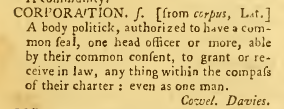
Corporate:
United in a body or community.
Corporation:
A body politick, authorized to have a common seal, one head officer or more, able by their common consent, to grant or receive in law, any thing within the compass of their charter: even as one man.
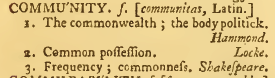
Community:
1. The commonwealth; the body politick.
2. Common possession.
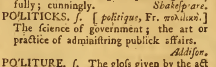
Politicks:
The science of government; the art or practice of administring publick affairs.
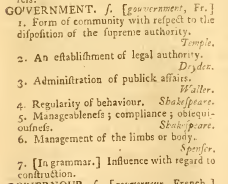
Government:
1. Form of Community with respect to the disposition of the supreme authority.
2. An establishment of legal authority.
3. Administration of publick affairs.
As you noticed; each definition uses one or more of the other four words as part of its own definition. Underlining above was added to emphasize the fact that government and corporation are synonymous.
With this, the government as a corporation perspective simplifies the search for the correct documents based on the purpose for those documents.
Many more people are comfortably familiar with what paperwork to look for in commercial corporations. This is taught in nearly all business and investment courses. The Founding Charter is the contract and enforceable law among the owners and controllers of the corporation they are creating. The By-Laws is the contract from the owners and controllers for measuring the qualifications and performance of the key corporate officers, who will generally be elected or appointed by the owners and or the controllers.
When we look at government as a corporation; the Corporation's Contract Paper-Trail, listed in the above paragraph makes total logical sense. Now, all we must do is identify what documents with government do those same things as a commercial corporation.
The unanimous Declaration of the thirteen united States of America: is The Founding Charter, the private law, if you will, among the people in all of the thirteen unified States (at that time) on the American continent from seventeen-seventy-six, right through to the present. It has never been replaced. It has never been amended. It has only been forgotten about, except for July 4th fireworks. Even then, The Declaration is almost never talked about. In fact, the name, The Declaration of Independence makes it much easier to forget and ignore. After all, the politicians tell us; "What do we need that old thing for. We have not been under British rule for over 250 years. It's old dead paper!"
With that, the people have all but forgotten about the most important contract among ourselves as citizens being, co-owners and co-controllers over government. The clause "consent of the governed", in The Declaration, makes the unified majority of the total body of registered voters, The Sovereign Authority over government; subject themselves, as that Sovereign, to the terms within The Declaration. The contractual vote-count is detailed in a later page.
The Declaration also contains our nation's real pledge, with respect to what we, as united States Americans are supposed to put at risk to keep our nation truly Free, Sovereign, and Independent. This pledge is detailed in a later page.
The Constitution of the United States of America: is The By-Laws generated from the governed people, as The Sovereign Authority to bind their key corporate officers in government.
The Constitution is the primary Job-Description sheet that the Human Resources Department, which is The Majority of the Total Body of Registered Voters are supposed to use to qualify candidates based on whether their promises support or violate The Constitution. Then, once legitimately elected in accord with the terms of The Declaration, The Constitution is supposed to determine if a government officer or government action needs to be stopped, or recalled, removed from office before the end of their elected or appointed term.
In addition to The Declaration & The Constitution, we must be familiar with two other document contracts: The Articles of Confederation and The Definitive Treaty of Peace.
The Articles of Confederation was our nation's first constitution. The reason this constitution is important, is so that we might better comprehend why some elements either did or did not make it into The Constitution of the United States of America. With that, we can determine if the changes made were for the better or the worse, and make corrections to better ourselves. A short list of issues include:
Non-consecutive term limits.
Supreme Court judges assembled as needed in the same manner of selecting jurors from a jury-pool.
The difference between the public storage of militia arms; to that of potentially every household storing military-militia type arms.
The Constitution of the United States of America in relation to The Articles of Confederation, is that it eventually replaced The Articles of Confederation in about seventeen-ninety.
Neither of the constitutions; The Articles of Confederation or The Constitution of the United States of America; replace the two prior contract documents of The Declaration or The Treaty, as they serve entirely different purposes. The Articles of Confederation & The Constitution of the United States of America serve identical purposes. The latter one replaces the former one. When it does, it must do so in accord with the terms of the former constitution.
The Definitive Treaty of Peace is the treaty that ended the war in favor of these united States of America. This is important for several reasons, but top of this list is proof that Great Britain did not actually grant independence to the united States of America. Great Britain acknowledged that the united States of America were in fact Free, Sovereign, and Independent States.
That distinction may seem trifling, but it is the same types of difference with the constitutional amendments regarding voting rights for people of color, sex, and age. The respective amendments do not grant the rights to vote to any of the parties named. The amendments prohibit government from violating their rights from that time on.
This link, Screenshot Glossary takes you to a Glossary of screenshots. This way, you can check my accuracy. Click here for the entire, downloadable
Old Dictionaries
If anyone wishes to debate or challenge any content within, please email Daniel Kingery via danielmkingery[at]gmail[dot]com.
The above definitions give us the correct perspective through which to view government. With that it establishes the relationship among these three activities.
The unanimous Declaration of the thirteen united States of America is —The Plan.
That Plan was to have a very well-informed population regarding how to control government.
Government was to be very strictly limited —but powerful enough to do its Constitutionally authorized job.
The Practice is what the government does.
The Constitution of the United States of America is the Law over government.
The government Practice, when compared with The Declaration, has simply continued us along the 1776 style of Tyranny and Despotism —on steroids. It no longer reflects the limitations against government powers detailed in The Constitution.
The Constitution has become, in the minds of the people, The Perception as to what is happening. The Perception, by many people, is that the government is only doing what is necessary to maintain a peaceable society.
A "peaceable" society with extremely high crime rates; and government violating nearly every constitutional limitation. Government exercising nearly every characteristic that The Declaration identified as a tyranny.
With the correct perspective established earlier, with the definitions, it simplifies the relationship between these three items.
The unanimous Declaration of the thirteen united States of America is the foundation upon which The Constitution is built. Without The Declaration's authority, those constitutional elements are void, —and must be repealed and not be exercised by government.
The Constitution does not replace The Declaration. They are intended to work together for securing the people's rights.
The Constitution is the framework upon which every law must hang. Without constitutional authority, that law is void, —and must not be enforced by the government.
The law does not replace The Constitution. They are supposed to work together to help secure and protect the people's rights.
The Law is tyranny, despotism, and treason when The Constitution does not authorize its existence.
The unanimous Declaration of the thirteen united States of America outlines a couple dozen political powers that help recognize a tyranny
The Constitution of the United States of America, Article 3, Section 3 defines the two types of treason. Details on tyranny, despotism, and treason are covered on a later page.
To do list:
• Become familiar with CleanHonestGov.Com content; at least, the first eight pages. These first eight pages cover the critical information. After that, it will allow access to the Site Map and all other pages. This can easily be done as reading material on the toilet. Or even faster with Natural Reader apps.
• Email questions and comments to danielmkingery[at]gmail[dot]com.
• Break out your contacts lists. All of them! Send them links to CleanHonestGov.Com, or any of the other pages, and get other people thinking and acting.
• Answer their questions, or refer them to me by forwarding them my email address: Daniel Kingery via danielmkingery[at]gmail[dot]com.
• Start an informal Presidential Campaign Committee, not for the purpose of raising funds, but to hold meeting and petition-signing for the purpose of boycott letters with lots of signatures; the more the better; to send to local, county, state, national, and international media resources to get them to cover this candidate, identified on the Clean Honest Government Home Page.
• Then, be strong about supporting and voting for this candidate, as voters make the decision, Not money.
• Remember: It will seem slow at the start. The ideal goal is to get at least one-hundred eighty-six million registered voters signing on. It sounds like a huge number to get in just thirty days.
The chart below, shows a constant growth-rate; doubling every day. That doubling almost never happens. It looks impossible, when at day twenty-five we would not even have one-tenth of what we need by the end of thirty days.
The more people working it, the faster the group grows.
When looking at the typical 60% of registered voters who routinely withhold their consent; we are nearly there already. It just becomes a process of showing them the best plans and the best ideas, with the candidate who; with the help of supporters; makes it happen.
As numbers grow, we gain traction, then; the rest becomes our history; and this generation has Clean Honest Government for the first time in our nation's young life.

